Granny square baby blankets are a beloved staple for crocheters of all skill levels.
These projects are modular, beginner‑friendly, and perfect for using up leftover yarn.
With endless opportunities for color combinations and creative layouts, they make thoughtful gifts for newborns and add a cozy, handmade touch to any nursery.
In this detailed guide, you’ll learn why granny square baby blankets are so popular, discover free pattern variations, explore material recommendations, and get practical tips for finishing your blanket neatly.
Whether you’re new to crochet or looking for inspiration for your next project, this article has everything you need to create a beautiful granny square baby blanket.
Why Choose a Granny Square Baby Blanket?
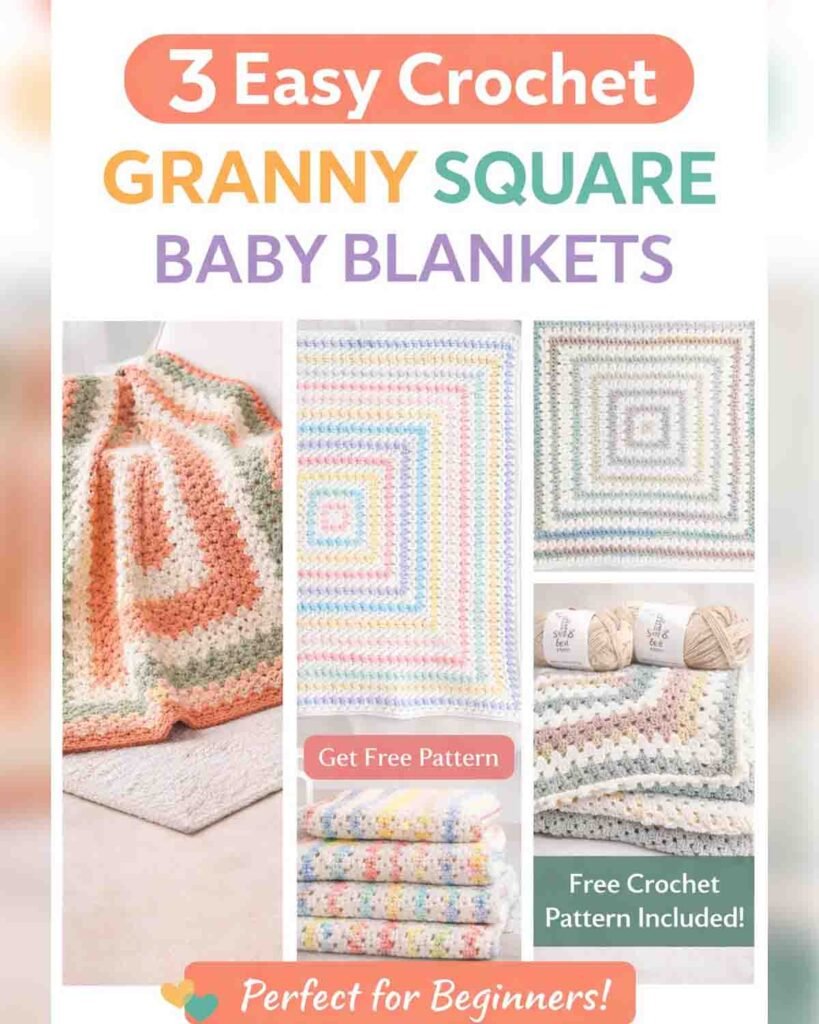
Granny squares are classic building blocks in crochet. When turned into baby blankets, they offer several advantages:
- Beginner Friendly – Granny squares use basic stitches (chains, double crochet, and single crochet) repeated in rounds. This makes them accessible to beginners and easy to memorize.
- Customizable Size – You can adjust the size by adding more rounds to a single giant square or by joining additional small squares. This flexibility allows you to craft blankets for loveys, stroller quilts, or larger crib blankets.
- Great Stash Buster – Granny squares are ideal for using up leftover yarn. You can mix and match colors creatively without having to buy new skeins for every project.
- Portable and Modular – Crochet squares individually during travel or short breaks, then assemble them at home. Working in small modules makes large projects feel manageable.
- Perfect for Gifting – Baby blankets are cherished gifts that can become heirlooms. You control the colors and design, so they’re easy to personalize for each family.
Materials and Tools
Selecting the right materials will ensure your blanket is soft, durable, and safe for babies.
Here’s what you need for two popular granny square baby blanket patterns.
Recommended Yarn Types
When crocheting for babies, choose yarn that is gentle on sensitive skin and easy to care for:
- Cotton – Natural, breathable, and hypoallergenic. Ideal for warm‑weather blankets or babies with sensitive skin. Cotton yarn can be slightly heavier and takes longer to dry.
- Acrylic – Affordable, widely available, and machine washable. Acrylic yarn is soft and holds up well to frequent washing but may not be as breathable as natural fibers.
- Bamboo – Silky, eco‑friendly, and naturally antibacterial. Bamboo yarn is lightweight and perfect for summer blankets, though it may stretch over time if crocheted loosely.
- Blended Yarns – Combining cotton and acrylic or other fibers offers the best of both worlds: softness, durability, and easy care.
Avoid fibers that shed (such as mohair or angora) and check labels for certifications like OEKO‑TEX or GOTS to ensure yarns are free of harmful chemicals.
Always test a swatch on your wrist or cheek – if it feels soft to you, it will feel comfortable for baby.
1. Granny Rectangle Crochet Baby Blanket Sunset Meadow
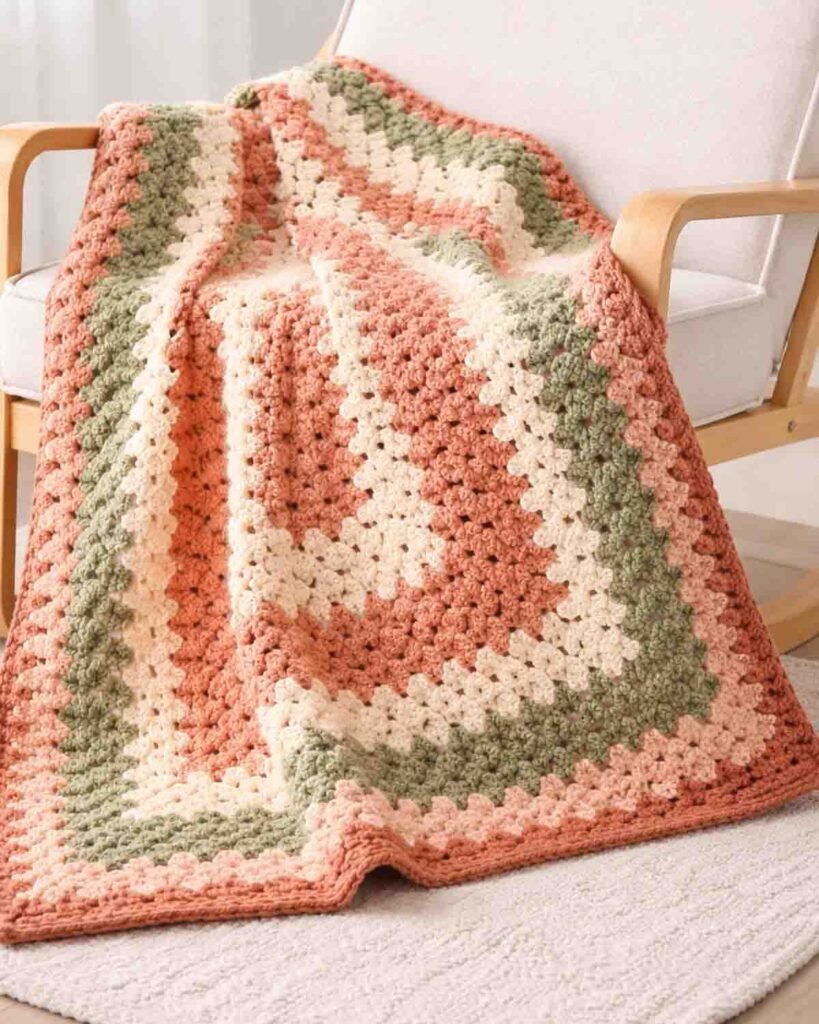
This gives a warm, modern feel instead of the blue dappled look from the PDF.
| Color | Yarn Shade (Example) | Use |
|---|---|---|
| Color A | Soft Cream | Center + grounding rounds |
| Color B | Blush Peach | Main body |
| Color C | Sage Green | Accent rounds |
| Color D | Muted Terracotta | Border / final rounds |
Color sequence suggestion
- Rounds 1–2: Color A
- Rounds 3–5: Color B
- Rounds 6–8: Color C
- Remaining rounds: Alternate B and C
- Final 2 rounds: Color D
This keeps the rectangle visually balanced and avoids harsh striping.
Granny Rectangle Baby Blanket Pattern
Materials
- Super bulky or bulky baby yarn (approx. 540–560 yards total)
- 6.5 mm (US K / 10.5) crochet hook
- Tapestry needle
- Scissors
Finished Size
Approximately 36 x 40 inches
(Size is adjustable by adding more rounds)
Abbreviations
| Term | Meaning |
|---|---|
| ch | chain |
| dc | double crochet |
| sl st | slip stitch |
| sp | space |
| rnd | round |
Pattern Notes
- The blanket is worked in continuous rectangular rounds
- Corners are formed using (3 dc, ch 2, 3 dc)
- All other spaces are worked with 3 dc
- Chain-3 at the start of each round counts as 1 dc
Instructions
Foundation
Ch 13
Round 1 (Base Rectangle)
- 2 dc in the 4th ch from hook
- Ch 1, skip 2 ch, 3 dc in next ch — repeat 2 times
- Ch 1, skip 2 ch
- In next ch work (3 dc, ch 2, 3 dc, ch 2, 3 dc) — this forms the first long corner
Now rotate your work and continue along the opposite side of the chain:
- Ch 1, skip 2 ch, 3 dc in next ch — repeat 2 times
- Ch 1, skip 2 ch
- In last ch work (3 dc, ch 2, 3 dc, ch 2)
Join with sl st to the top of beginning ch-3.
Round 2
- Sl st into the next 2 dc and into the ch-1 space
- Ch 3, 2 dc in same space
- Ch 1, 3 dc in next ch-1 space — repeat 2 times
- In the next corner space: (3 dc, ch 2, 3 dc)
- Ch 1
- In the next corner space again: (3 dc, ch 2, 3 dc)
Continue:
- Ch 1, 3 dc in each ch-1 space across the long side
- Work (3 dc, ch 2, 3 dc) in each corner space
Join with sl st.
Round 3 and Beyond
For all following rounds:
- Slip stitch to the next ch-1 space
- Ch 3, 2 dc in same space
- Work 3 dc in every ch-1 space
- Work (3 dc, ch 2, 3 dc) in every ch-2 corner space
- Ch 1 between each group
Each round will naturally grow the rectangle, adding one extra granny group per side.
Finishing
- Continue working rounds until the blanket reaches the desired size
- Fasten off and weave in all ends securely
- Optional: Add a single-color sc or reverse sc border for a clean finish
2. Boundless Granny Square Baby Blanket Free Pattern
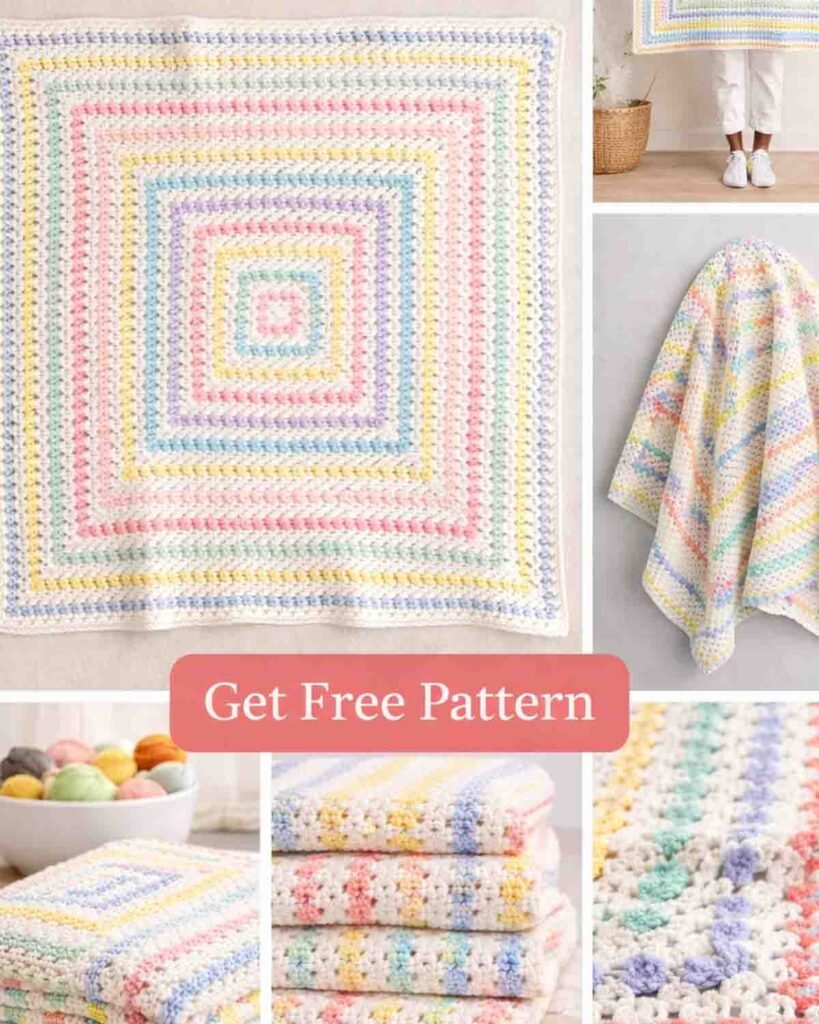
A granny square that grows endlessly, round after round, creating a timeless blanket with gentle stripes and a relaxed, modern feel. This project is calming to work on and rewarding to watch as each round adds character and balance to the square.
Worked in smooth, machine-washable cotton yarn, this blanket is lightweight yet cozy, making it ideal for warm climates, babies, or everyday throws.
Yarn & Color Concept (Different Palette)
Color Theme: Calm Earth
This version uses a softer, grounded palette instead of bright garden tones.
| Role | Color Name | Description |
|---|---|---|
| Main Color (MC) | Warm Ivory | Clean base that ties everything together |
| Contrast A | Soft Olive | Natural, earthy accent |
| Contrast B | Dusty Clay | Warm muted stripe |
| Contrast C | Mist Blue | Cool contrast |
| Contrast D | Pale Mustard | Gentle pop of color |
These colors rotate slowly, keeping the square visually balanced without overwhelming stripes.
Materials
- Main Color: Sport-weight cotton yarn, approx. 1,200–2,400 yards depending on size
- Contrast Colors A–D: Sport-weight cotton yarn, small amounts (70–180 yards each)
- Crochet hook: 3.5 mm (US E)
- Scissors
- Tapestry needle
Finished Sizes
- Crib: approx. 34 inches square
- Small Throw: approx. 48 inches square
Sample shown is the Small Throw size.
Gauge
Rounds 1–6 measure approximately 4¼ inches square.
Exact gauge is not critical, but consistency matters.
Abbreviations
| Term | Meaning |
|---|---|
| ch | chain |
| dc | double crochet |
| sl st | slip stitch |
| sp | space |
| rnd | round |
| MC | main color |
Pattern Notes
- Blanket is worked in continuous rounds, turning is not required
- Corners normally use (3 dc, ch 2, 3 dc)
- To correct twisting, occasional Reset Rounds are used
- Reset Rounds replace the corner with (2 dc, ch 2, 4 dc)
- Color changes happen at the start of a new round
Granny Square Basics
If this is your first granny square, practice making:
- Double crochet
- Chain spaces
- Slip stitch joins
Once mastered, the rest of the blanket follows a repeating rhythm.
Instructions
Begin
With Contrast Color A, ch 4 and join into a ring with a slip stitch.
Round 1
Ch 3 (counts as dc), 2 dc into the ring, ch 2.
[3 dc into the ring, ch 2] three times.
Join with sl st to the top of beginning ch 3.
You now have 4 corners and 4 granny clusters.
Fasten off Contrast Color A.
Round 2
Join Main Color (MC) to any corner space.
Ch 3, 2 dc in same space.
[ch 1, (3 dc, ch 2, 3 dc) in next corner] three times.
Ch 1, 3 dc in first corner space.
Ch 2 and join with sl st.
Round 3 (Reset Round)
Ch 3, 3 dc into the same corner space.
[ch 1, 3 dc in next ch-1 space, ch 1, (2 dc, ch 2, 4 dc) in corner] three times.
Ch 1, 2 dc in starting corner.
Ch 2, join with sl st.
This round helps keep the square straight.
Round 4
Ch 3, 2 dc in same corner.
[ch 1, 3 dc in each ch-1 space until corner, (3 dc, ch 2, 3 dc) in corner] around.
Join with sl st.
Round 5 (Reset Round)
Ch 3, 3 dc in same corner.
[ch 1, 3 dc in each ch-1 space until corner, (2 dc, ch 2, 4 dc) in corner] around.
Join with sl st.
Fasten off MC.
Stripe Sequence
- Join Contrast Color B and work Round 4 only
- Fasten off
- Join MC and work Rounds 4 and 5
- Fasten off
- Join Contrast Color C, work Round 4, fasten off
- Repeat MC rounds
- Continue rotating Contrast Colors D, A, B, then back to C
Each contrast color appears only on one round at a time, creating clean, spaced stripes.
Continue Working
Repeat the stripe sequence until you reach:
- 46 rounds for Crib size
- 66 rounds for Small Throw size
Finish with 2 final rounds in MC for a clean border.
Finishing
- Fasten off and weave in all ends securely
- Gently wet block to square the blanket and smooth edges
- Allow to dry completely before use
3. Evergreen Calm Granny Square Baby Blanket
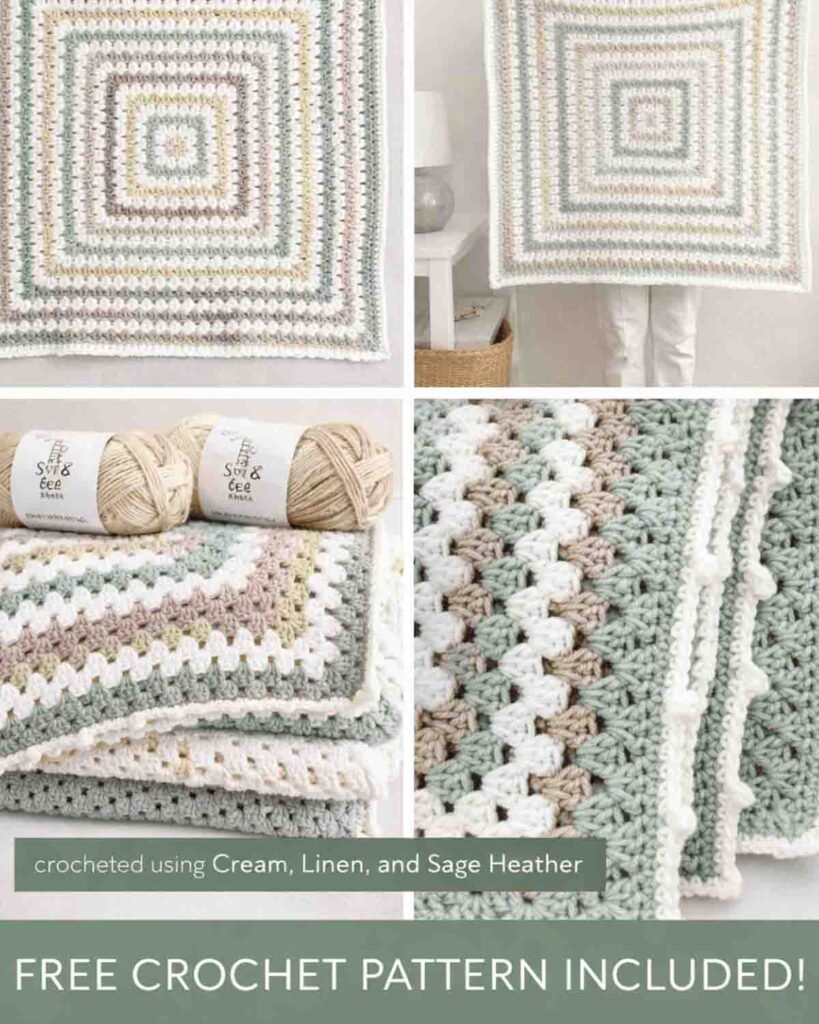
This granny square blanket is a modern take on a classic design, created with a calming color palette and tighter stitch placement to reduce large gaps.
The result is a soft, cozy blanket with an heirloom feel that works beautifully as a baby blanket or decorative throw.
The finished blanket shown here measures approximately 29 inches square, but the size is fully adjustable.
Instructions for resizing are included at the end of the pattern.
Materials
- 5.5 mm (I/9) crochet hook
- Approximately 685 yards of worsted-weight yarn
- Yarn colors used
- Viridescent – 2 skeins
- White – 1 skein
- Linen – 1 skein
- Tapestry needle
- Scissors
If you prefer a print-friendly, ad-free version, this pattern can be converted into a PDF for personal use.
Finished Size
Approximately 29 inches by 29 inches
Size can be increased or decreased by adding or removing rounds.
Pattern Notes
- Gauge is not important for this project
- Adjust hook size based on your tension
- At the end of each round, there will always be 4 chain-1 spaces that form the corners
- The blanket is worked in continuous rounds
- Color changes occur at the start of rounds
Abbreviations
dc – double crochet
sc – single crochet
hdc – half double crochet
sl st – slip stitch
ch – chain
Special Stitch
dc cluster
Three double crochets worked into the same stitch or space
The starting chain and first two double crochets of each round count as the first cluster
Granny Square Blanket Pattern
Round 1
Using Viridescent, chain 3.
Work 2 double crochets into the third chain from the hook, chain 1.
Work a dc cluster into the same chain, chain 1, repeat two more times.
Slip stitch to the top of the beginning chain to join.
At the end of this round, you will have 4 dc clusters and 4 chain-1 spaces.
Round 2
Slip stitch into the next two stitches and into the corner chain-1 space.
Chain 2, work 2 double crochets into the same space, chain 1.
Work a dc cluster into the same space.
In the next corner space, work a dc cluster, chain 1, dc cluster.
Repeat around.
Slip stitch to the top of the beginning chain to join.
You will now have 8 dc clusters and 4 chain-1 spaces.
Round 3
Slip stitch into the next two stitches and into the corner space.
Chain 2, work 2 double crochets into the same space, chain 1, dc cluster.
Work a dc cluster into the space between clusters from the previous round.
Continue around by working a dc cluster into each space between clusters and completing the corners with dc cluster, chain 1, dc cluster.
Slip stitch to join.
At the end of this round, you will have 12 dc clusters and 4 corner spaces.
Rounds 4–27
For all remaining rounds, repeat the following sequence.
Slip stitch into the next two stitches and into the corner space.
Chain 2, work 2 double crochets into the same space, chain 1, dc cluster.
Work dc clusters into each space between clusters until the next corner.
At the corner, work dc cluster, chain 1, dc cluster.
Repeat around and slip stitch to join.
Stripe Sequence
- 8 rounds Viridescent
- 2 rounds White
- 2 rounds Linen
- 2 rounds Viridescent
- 2 rounds White
- 2 rounds Linen
- 2 rounds Viridescent
- 2 rounds White
- 2 rounds Linen
- 3 final rounds Viridescent
Do not cut yarn after the final round of the blanket.
Border Instructions
Round 28
Slip stitch into the next two stitches and into the corner space.
Chain 1.
Work single crochet around the entire blanket.
At each corner, work single crochet, chain 2, single crochet.
Slip stitch to join and fasten off.
Round 29 (Picot Edge)
Join White yarn in any corner with a slip stitch.
Single crochet in the same space and in the next five stitches.
Chain 2, work half double crochet into the second chain from the hook to form a picot.
Continue working six single crochets followed by a picot stitch around the edge.
In each corner, work single crochet, picot, single crochet.
Slip stitch to join and fasten off.
Minor spacing differences between picots will not be noticeable once finished.
Adjusting the Size
To make the blanket smaller, work fewer rounds.
To make it larger, add more rounds following the established pattern.
To maintain the stripe sequence, work two rounds of each color until the final Viridescent section, which should always end with three rounds.
Granny Square Variations
This pattern works beautifully with other granny square styles, including floral centers, heart motifs, and textured designs.
Feel free to experiment once you are comfortable with the construction.
Joining and Border Techniques
Joining your granny squares neatly and choosing the right border will give your blanket a professional finish:
- Join‑as‑You‑Go: Seam squares together during the final round of each square. This saves time and creates a flat, seamless join.
- Slip Stitch Seam: Crochet the squares together after completing them. Place squares wrong sides together and slip stitch through the back loops only for a nearly invisible seam.
- Whip Stitch Seam: Sew squares together using a tapestry needle and matching yarn. Work through the top loops of each square to keep seams flat.
- Border Options: A simple single‑crochet border is easy and straightens edges. For a decorative finish, try a picot border (sc in next 6 stitches, ch 2, hdc in second chain) or a shell border (5 dc in one stitch, skip next stitch).
- Stripe Border: Repeat one or two rows of each color used in your blanket to frame the design and tie the palette together.
Choosing Baby‑Safe Yarn
When making baby blankets, always think safety first. Here are essential guidelines:
- Choose Soft Fibers: Opt for cotton, acrylic, bamboo, or soft blends. Avoid yarns that shed or have metallic strands.
- Check Certifications: Look for OEKO‑TEX Standard 100 or GOTS labels, which indicate the yarn is free from harmful chemicals.
- Tight Stitches: Work tight enough to avoid large holes that little fingers or toes could catch in. Avoid using long fringe or beads.
- Secure Seams: Weave in all ends securely and check seams for durability. If adding toys or appliqués, sew them firmly and avoid glued items.
- Pre‑wash: Wash your finished blanket in a gentle cycle before gifting. Use mild detergent and avoid fabric softener.
Tips for Straight Edges and Finishing
Keeping your blanket edges straight and neat can be challenging. Try these tips:
- Count Your Stitches: Regularly count your stitches to make sure you aren’t accidentally adding or skipping stitches.
- Use Stitch Markers: Place markers on the first and last stitches of each round or row to help maintain consistent edges.
- Maintain Tension: Consistent tension is key for even rows. If your edges are wavy, check for uneven tension or miscounted stitches.
- Add a Border: A single crochet border smooths out minor inconsistencies and strengthens the edges.
- Block Your Blanket: Wet or steam blocking helps relax stitches and straighten edges. Always check the yarn label first to ensure the yarn is safe for blocking.
Frequently Asked Questions
Is a granny square blanket safe for babies? Yes, as long as you use soft, hypoallergenic yarn, avoid embellishments, and work tight stitches. Always secure seams and weave in ends thoroughly.
How much yarn do I need? It depends on the pattern and the size. A giant granny square blanket requires roughly 685 yards of worsted yarn. A 100‑square blanket made with DK yarn uses around 800 m of colored yarn plus 650 m of neutral yarn for joining.
What is the best yarn weight for baby blankets? DK and worsted weights are common choices. DK works well for soft, lightweight blankets, while worsted weight creates a slightly thicker, warmer blanket.
How do I calculate the number of squares? Divide each dimension of your blanket by the size of one square, round up, and multiply the two results. For example, a 36 × 42 inch blanket using 4 inch squares needs about 99 squares.
Conclusion
Granny square baby blankets are timeless projects that allow you to express your creativity with colors, textures, and layouts.
With the right yarn, tools, and techniques, you can create a cozy, durable blanket for any baby. Use this guide to choose your materials, follow one of the free patterns, and customize the design to suit your style. Happy crocheting!